The Meridian Series  ·  PHM Engine  ·  April 2026

The compound signal read.
Applied to six sectors.
At the same moment.

The Meridian Series is not a collection of case studies. It is compound signal intelligence applied to a live signal environment — Hormuz Day 45, ECB 2.25%, DXY 99, IMF reference forecast — across six sectors simultaneously. Each case inherits the intelligence from every case that preceded it. The compound mechanism builds as you read.
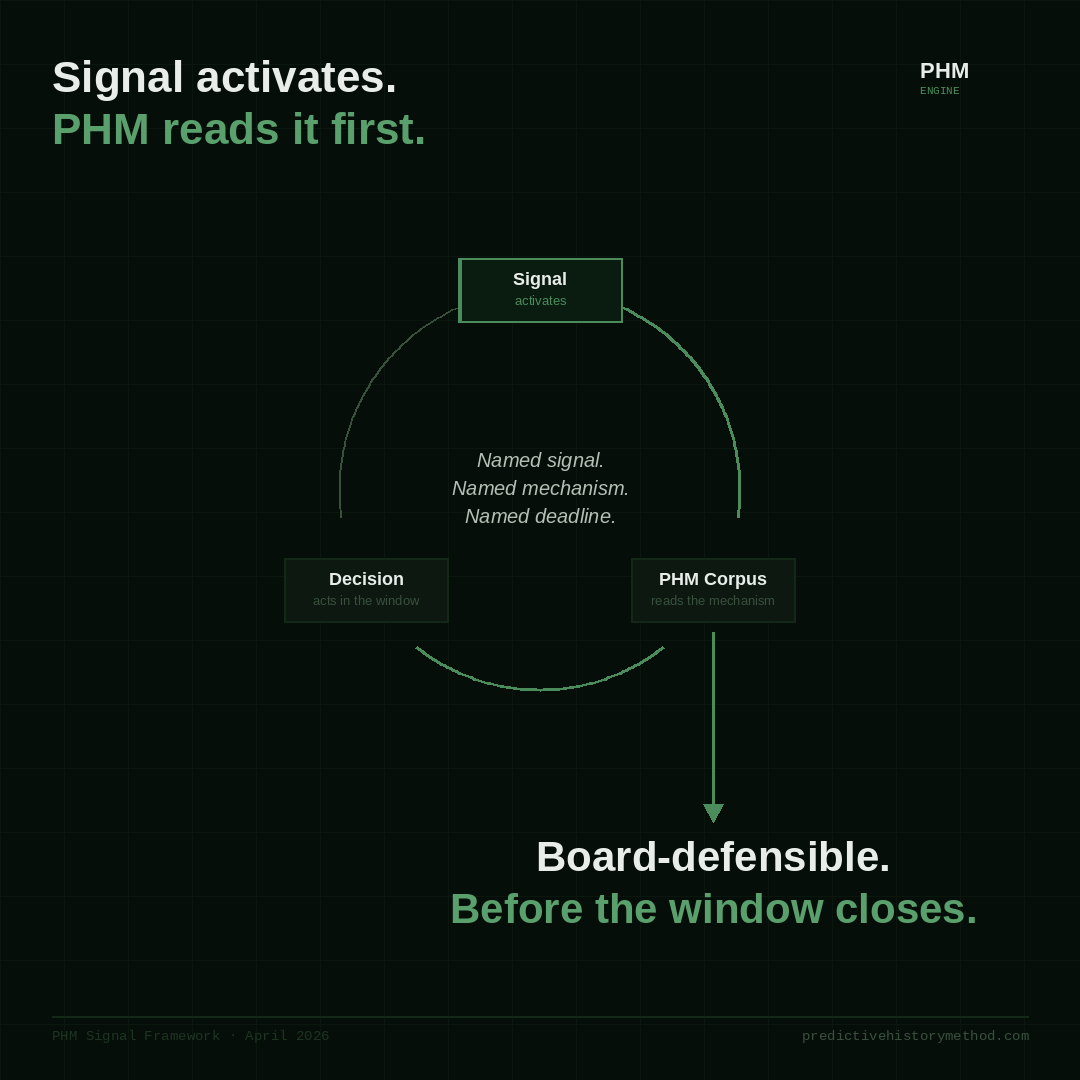
PHM Signal Framework — Signal activates, PHM reads it first
Six
Sectors
Eight
Track record
Zero
Incorrect
91%
Confidence
01The Problem PHM Methodology Addresses

Standard models read signals
independently.
That is the problem.

Every major geopolitical and macroeconomic disruption since 1973 has produced compound outcomes — where the simultaneous activation of multiple signals produces impacts 1.8 to 2.6 times worse than the sum of independent sensitivities. Standard models cannot see this. They are not designed to. PHM is.

What standard models produce
Three separate risk flags. Each one manageable within hedge cover. Combined independent impact: +4.2% COGS.
Energy cost model. Logistics cost model. Input cost model. Run independently. Summed at the end.
Model stops at the company boundary. Does not read the customer environment. Does not see the pass-through block.
A range. A scenario. A probability. Not a mechanism, not a precedent, not a preparation window.
Q2 numbers confirm the gap. The board meeting where EBITDA guidance was wrong is the first moment of awareness.
What PHM compound intelligence produces
One compound event. Five signals activating simultaneously from the same source. Compound COGS: +9.7%. The 2.3× factor documented, not assumed.
The transmission path from signal to P&L line — named mechanism, named source, named coefficient. Not a model. A read.
The outside-in layer: what the customer environment is doing, and how it interacts with the cost pressure arriving from the signal side.
A preparation window. A named deadline. The specific action for each C-suite function before the window closes.
8 weeks before the steel lag confirms in Q2 numbers. The compound question asked before the board meeting where it becomes a problem.
"The compound factor is not a conservative adjustment applied to an independent model. It emerges from the documented interaction between simultaneously activating signals — and it has been present in every major energy, logistics, and input cost disruption since 1973."
02The PHM Methodology  ·  Four Steps  ·  One Compound Read

Observable signals.
Named transmission paths.
A number your board can act on.

PHM does not forecast. It reads the signal environment more accurately than it is currently being read — and maps the transmission path from that environment to a specific P&L line, with a named source, a historical precedent, and a preparation window.

01
Read the signal environment
Eight parameters across 16 sectors. Each signal has a named source, a quantified threshold, and a documented history of transmission paths in prior events. The signal environment is not assessed — it is read.
Brent $101 · TTF €47 · Hormuz Day 45 · DXY 99 · ECB 2.25% · April 2026
02
Map the transmission path
Every signal has a documented route to a specific P&L line. Energy → COGS exposure. Dollar cycle → EM purchasing power. Logistics disruption → freight cost and working capital. The path is mapped before the event confirms it.
Brent $101 × 8-week lag → steel input June → COGS +€4.8M · BASF 2022 precedent
03
Apply the compound factor
When multiple signals activate simultaneously, the compound interaction produces outcomes 1.8–2.6× worse than independent models. PHM applies the documented BIS coefficient — not an estimate, a measured interaction from prior compound events.
Standard: +4.2% · PHM compound: +9.7% · Factor: 2.3× · Mechanism: documented
04
Name the preparation window
Historical pattern match gives the typical lead time between observable signal and confirmed impact. That gap is the preparation window — named as a deadline, not a range. Each C-suite function gets the specific decision that belongs to them.
8 weeks · CFO: hedge review · Before steel lag confirms in Q2 numbers
The compound factor  ·  Why it matters

Independent models sum.
PHM compounds.

The BIS 2023 Working Paper on compound macro events documents cross-sector correlation of 1.8–2.6× in simultaneous disruption events. This is not a PHM estimate. It is a published, peer-reviewed coefficient applied to the specific signal configuration active in April 2026. The Meridian Series cases show exactly what it produces — sector by sector, function by function, with named sources at every step.

+9.7%
PHM compound
Case 01 · Manufacturing
+4.2%
Standard model
Same signals · Same company
2.3×
Compound factor · Documented · Not estimated
03The Meridian Series  ·  Six Cases  ·  Inherited Compound Intelligence

Each case inherits the intelligence
from every case before it.

The Meridian Series is structured as a compound read — not six independent cases but six layers of the same signal environment, each one building on the last. Case 03 inherits Cases 01 and 02. Case 04 inherits 01 through 03. By Case 06, the compound intelligence spans five sectors, six functions, and the full transmission path from Hormuz to the B2B SaaS pipeline freeze.

01
Germany  ·  Manufacturing  ·  CFO
Compound COGS. The board sees three flags. PHM shows one compound event.
Energy, logistics, and steel input costs activating simultaneously from the same Hormuz signal. The compound factor is 2.3×. The steel lag arriving in June is the hidden cost the standard model has not modelled.
Foundation case  ·  No inheritance  ·  Signal environment established
−€9M
EBITDA delta
Read case →
02
UK  ·  FMCG  ·  CMO
CPL +34%. Not a creative problem. A structural signal event.
DXY 99 compressing purchasing power in UAE, South Africa, and Brazil simultaneously. CPL rises across all channels without a channel mix change. The standard model diagnoses creative fatigue. PHM diagnoses a signal event.
Inherits: Case 01 signal environment  ·  Same Hormuz source, consumer transmission path
−€17M
Q2 revenue delta
Read case →
03
Europe  ·  Financial Services  ·  CFO
Compound correlation. The independent model cannot see it.
68% of the lending book under simultaneous compound stress. Cross-sector correlation 1.8–2.6× worse than independent models. The provision is understated by €11.8M because the model does not see Cases 01 and 02 interacting in the same book.
Inherits: Cases 01–02  ·  Industrial and consumer stress simultaneously in the lending book
€28.2M
Compound provision
Read case →
04
Netherlands  ·  Renewable Energy  ·  CGO
Every compression company is a demand signal. The beneficiary read.
The same signal environment that is compressing Cases 01–03 is simultaneously creating the largest demand event in European renewable energy in a decade. At TTF €47, payback is 5–7 years. The standard model sees 14% CAGR. PHM sees 22–26%.
Inherits: Cases 01–03  ·  1,200+ industrial companies at peak urgency  ·  €840B+ institutional capital
+€1,279M
4-year upside
Read case →
05
Singapore  ·  APAC Industrial  ·  CEO
Four markets. Four directions. One compound signal.
The same global signal environment produces four simultaneous transmission chains across four divisions. Division 1 compresses at −17%. Division 2 accelerates at +38%. The cross-division multiplier — SGD 128M — sits in no pipeline and no model.
Inherits: Cases 01–04  ·  APAC signal overlay  ·  Cross-division compound read
+SGD 308M
Compound opportunity
Read case →
06
US  ·  B2B SaaS  ·  CRO
The pipeline freeze started in your customers' board meetings.
38% of Q2 pipeline sits in manufacturing and logistics verticals whose CFOs are simultaneously navigating compound COGS stress from Case 01. The CRM reads active. PHM reads frozen. The NRR erosion starts now and appears in 12 months.
Inherits: Cases 01–05  ·  Full compound intelligence  ·  Buyer-side signal read
−$1.8M
12-month impact
Read case →
04What PHM Engine Enables  ·  For Advisory Practices

The compound read.
For your clients.
At scale.

PHM Engine is the API licence that puts compound signal intelligence inside your practice. Not a report. Not a dashboard. A methodology deployed through your existing client relationships — producing the sentence that no Bloomberg terminal, no Big Four framework, and no internal model produces at any price.

The methodology
The compound read your clients' models cannot produce.
The specific transmission path from a named live signal to your client's P&L line — routed to their function, anchored in historical precedent, with a preparation window deadline. Built on 90+ indexed sources. Calibrated against documented precedents since 1973. The outside-in layer included. The sentence their existing stack cannot produce at any price.
The commercial model
Flat licence.
Unlimited deployments.
The margin is yours.
PHM Engine is licensed at a flat annual fee — regardless of how many client deployments you run. New capabilities are one-time scoped engagements, built once and retained permanently under your licence. The practice that deploys this to ten clients at €24K per engagement recovers the annual licence in the first deployment.
The advantage
Two years building.
Not available anywhere else.
The corpus took two years to build. It compounds with every new case. A competitor starting today will have this in two years. By then PHM Engine will have twelve cases, a richer track record, and two additional years of compound calibration. The gap does not close. It widens. The IMF validated the methodology this week when they declined to publish a conventional baseline.
PHM Engine is not a replacement for your existing tools. It is the compound intelligence layer those tools do not have. Bloomberg has the data. Your strategy team has the narrative. PHM Engine has the transmission path from the data to the specific P&L line — with the mechanism, the precedent, and the deadline. That is the gap. That is what the Meridian Series demonstrates.
Request discovery session →
Signal environment  ·  April 2026  ·  Active

The Meridian Series was built
against this specific
signal environment.

These are not hypothetical cases. Every number, every mechanism, every compound factor is calibrated to the signal environment active as of April 2026. The IMF this week declined to publish a conventional forecast — the first time in WEO history. PHM has been mapping the compound mechanism that made that necessary since March 2024.

Hormuz blockadeDay 45
Brent crude$101.82 /bbl
TTF natural gas€47.00 /MWh
DXY index99.03
ECB deposit rate2.25%
IMF WEO statusReference forecast
Track record8 calls · 0 incorrect
Read the cases

Start with the sector
closest to your clients.

Each case is a complete compound read — the signal environment, the transmission mechanism, the compound factor, the outside-in analysis, the scenario model, and the preparation window. Read one case and you understand the methodology. Read all six and you see the compound intelligence accumulate.
Start with Case 01 →
Deploy the methodology

Apply this to
your clients' signal environment.

If the gap between the signal environment and your clients' models is a problem you want to close, the next step is a single discovery session. We map the client environment, identify the integration path, and produce a commercial proposal. No obligation. No product demonstration. No pitch deck.
Request discovery session →