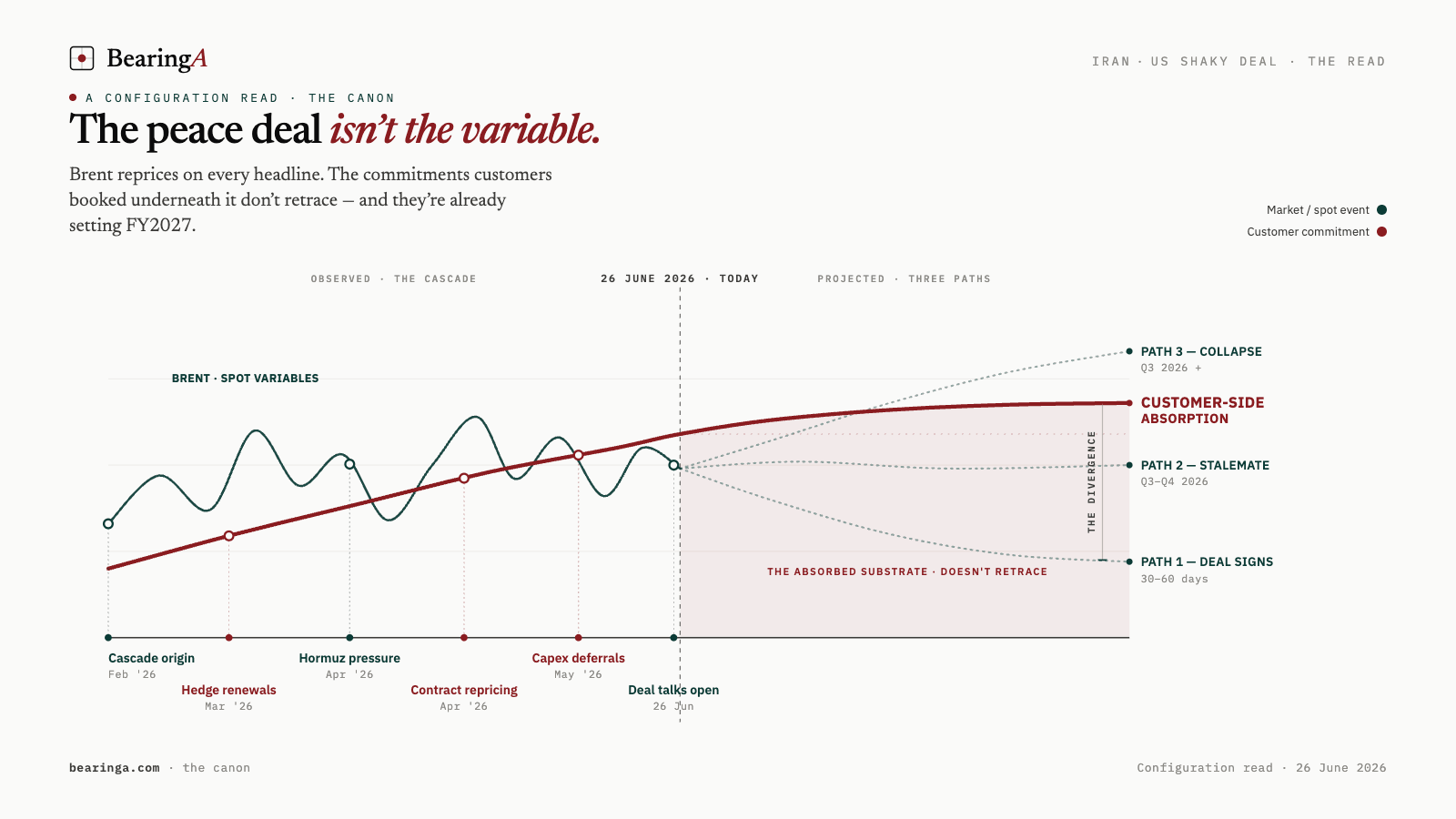
Oil pulled back from $126 to $97 in late May when the deal looked imminent. The Islamabad Memorandum signed 17 June. Brent retraced toward pre-war levels through late June — Path 1 activated. IRGC struck three tankers 7 July. Trump declared the MoU over at the NATO Turkey summit 8 July. Path 3 activated from inside Path 1's operating baseline. Brent at $78.82 on 13 July (September futures close); TTF at €48.8/MWh on 11 July. Your customers stopped pricing the deal months ago — they already absorbed the decisions that determine the next four quarters, and none of those decisions retrace when the deal signs — or when it collapses. The three-week interlude added a second absorption layer on top of the first. The cascading impact runs forward on customer P&L cycles independent of which path lands next.
What activates. Path one — deal signs in 30–60 days. Spot variables retrace hard. Brent toward $80, equity rally in industrial cyclicals, freight indices reverse as Cape routing reverses. But customer-side commitments made during the cascade window run forward on their own tenor structures. Multi-quarter supply contracts, hedge books rolled at sustained elevated tenor pricing, capex committee meetings that deferred investment during Q1–Q2 2026 — none retrace on deal signing. By Q3–Q4 2026 earnings season, the divergence surfaces and the recovery rally faces a second-order correction.
What persists. Path two — compound continues through Q3–Q4 2026. Spot variables hold at the current elevated plateau. The market gradually accepts the the compound as operating reality. Each quarter the compound continues, more customer-side commitments absorb into the elevated baseline. More contracts reprice. More hedges roll at the structural cost floor. By Q4 2026 the absorbed substrate is materially deeper than it was in Q2 2026.
What contradicts. Path three — collapse into renewed conflict. Spot variables spike. Brent toward $130, TTF €55+, war risk premiums double. Customer-side absorption already committed during the compounding period was made under compounding-baseline or moving-toward-resolution assumptions. Renewed conflict invalidates the compounding baseline. Contracts negotiated against the compounding floor become structurally underpriced and require renegotiation. A second wave of customer-side absorption, larger than the first because the conflict baseline is now higher.
What this is not. PHM does not call which resolution path lands. The methodology reads the configurational claim that survives across all three: customer-side absorption is structurally distinct from spot retracement; the absorbed substrate has been growing for the full duration of the cascade; the cascading impact runs forward on customer P&L cycles independent of the deal resolution. That claim does not depend on which path lands. It is configurationally observable today.
The structural claim that survives across all three paths. Customer-side absorption is structurally distinct from spot retracement. The absorbed substrate has been growing for the full duration of the cascade. The cascading impact across the next 2–4 quarters runs through customer P&L cycles independent of when or how the peace deal resolves. This claim does not depend on which path lands. It does not require a probability estimate. It is configurationally observable today.
Where the read weakens. If customer-side absorption is shallower than the corpus suggests — if multi-quarter contracts have shorter tenors than typical, if hedge books are smaller, if capex deferrals were thin to begin with — the cascading impact compresses. The structural claim still holds; the magnitude does not. If the market is already pricing absorbed-substrate retracement into equity valuations (rather than only pricing spot retracement), the divergence is smaller than the corpus implies. Sub-sector resolution is required. The aggregate "industrial recovers when Hormuz reopens" framing collapses at sub-segment composition; if a specific reader's customer base is structurally insulated from the cascade, the read does not apply at their resolution.
What this is not. PHM does not call which resolution path lands. The methodology does not produce a probability estimate on the deal. Wrong calls on the path compound the methodology's calibration; over-confident calls compound nothing. The published call is the configurational claim that survives across all three paths — not a forecast on which path the market should price toward. Each condition above is named and corpus-anchored. None is generic hedging. The methodology's defensibility rests on these conditions being explicit, not on the call being right.
What happened between 17 June and 8 July. The Islamabad Memorandum signed 17 June triggered Path 1. Brent retraced toward pre-war levels through late June. Your customers who had been absorbing Path 2 — the compound as operating reality — shifted their forward assumptions accordingly. Contracts negotiated inside the MoU window, hedge books rolled against the MoU-stable baseline, capex committees that had deferred meeting again under a tentative reopening signal. Three weeks of Path-1-stable operating decisions on top of four months of continuous compounding. Then the governance-of-transit fault line that the MoU did not address surfaced mechanically: Iran's corridor authority asserted against vessels off the approved route, IRGC enforcement against three tankers 7 July, US strike response 8 July, Trump's NATO-summit-Turkey declaration. Brent from the MoU-window trough back to $74 on 7 July, $78 on 8 July, $78.82 on 13 July (September futures close, Al Jazeera). TTF from early-July ~€40 to €50 intraday 10 July (one-month high), €48.8 close on 11 July (Trading Economics). The market priced best-case for three weeks and then repriced in four days.
The second absorption layer. Customer-side commitments made during the MoU window operated under Path-1-stable assumptions. Renewed conflict — Path 3 activating from inside Path 1's operating baseline — does not simply return those commitments to the compounding floor they were made from. Contracts negotiated against the MoU-stable Brent trough require renegotiation against the Path 3 baseline. Hedge books rolled at the MoU-window trough are structurally underpriced against the renewed-conflict environment. The cascading impact this quarter is therefore larger than continued compounding alone would have produced: the absorbed substrate has two layers compounded — four months of pre-MoU compounding absorption plus three weeks of MoU-window absorption, both now re-priced upward against Path 3 operating conditions. Your FY2027 planning surface sits underneath both layers simultaneously.
What the market got wrong — and what this entry got right. The analyst-desk read at 13 July (Yip, IG Sydney): "Oil's return towards pre-war levels in June reflected markets pricing in a best-case outcome for the fragile US-Iran arrangement; last week's re-escalation exposed how fragile that assumption was." That is the market-analyst version of what this entry composed on 26 June at cannot-be-wrong altitude: the peace deal is the wrong variable to watch. The market priced the deal; your customers absorbed the configuration. The MoU interlude did not reverse their absorbed commitments. The Path 3 collapse does not either. The structural claim survives: customer-side absorption is distinct from spot retracement, and it was — empirically, across the three-week interlude and the Path 3 re-collapse that followed.
The compound going forward. Kavonic (MST Financial, 8 July 2026): "Iran fully intends to cement its control over the Strait of Hormuz in the coming weeks, which is unacceptable to the US, many Gulf states and global customers, and could result in passage through the strait remaining below 50 percent of pre-war levels for many months, with periodic flare-ups in hostilities." That is not event-shaped. That is compound-shaped — a structurally lower-plateau operating regime with recurring escalation cycles. Your Q3 and Q4 planning surfaces are composed against that operating shape. The dual-channel observation: US officials committed to continued technical-track negotiations on 10 July even as the public-channel strikes were underway. A MoU-2 window remains possible. If it opens, the absorption-layer analysis above applies again — any three-week interlude inside a longer arc creates a new commitment layer that Path 3 re-activation subsequently re-prices.
PHM reads configurations the market is mispricing. This is one. The cascading impact across the next 2–4 quarters lands at sector and sub-sector resolution — where business decisions get made, not where macro probabilities get estimated. For vendors whose business reads in this configuration, the buyer-specific extension is BearingA: reading your customer-base substrate at sub-cohort resolution against this configurational state, against your specific commercial architecture, against your specific FY2027 planning surface.
Run the diagnostic → Back to Signal Watch